 Add to Chrome
 Add to Firefox
 Add to Edge
STAPO: Stabilizing Reinforcement Learning for LLMs by Silencing Rare Spurious Tokens
Feb 17, 2026
Reinforcement Learning (RL) has significantly improved large language model reasoning, but existing RL fine-tuning methods rely heavily on heuristic techniques such as entropy regularization and reweighting to maintain stability. In practice, they often experience late-stage performance collapse, leading to degraded reasoning quality and unstable training. We derive that the magnitude of token-wise policy gradients in RL is negatively correlated with token probability and local policy entropy. Building on this result, we prove that training instability is driven by a tiny fraction of tokens, approximately 0.01\%, which we term \emph{spurious tokens}. When such tokens appear in correct responses, they contribute little to the reasoning outcome but inherit the full sequence-level reward, leading to abnormally amplified gradient updates. Motivated by this observation, we propose Spurious-Token-Aware Policy Optimization (STAPO) for large-scale model refining, which selectively masks such updates and renormalizes the loss over valid tokens. Across six mathematical reasoning benchmarks using Qwen 1.7B, 8B, and 14B base models, STAPO consistently demonstrates superior entropy stability and achieves an average performance improvement of 7.13\% over GRPO, 20-Entropy and JustRL.

On the Equilibrium between Feasible Zone and Uncertain Model in Safe Exploration
Feb 04, 2026Ensuring the safety of environmental exploration is a critical problem in reinforcement learning (RL). While limiting exploration to a feasible zone has become widely accepted as a way to ensure safety, key questions remain unresolved: what is the maximum feasible zone achievable through exploration, and how can it be identified? This paper, for the first time, answers these questions by revealing that the goal of safe exploration is to find the equilibrium between the feasible zone and the environment model. This conclusion is based on the understanding that these two components are interdependent: a larger feasible zone leads to a more accurate environment model, and a more accurate model, in turn, enables exploring a larger zone. We propose the first equilibrium-oriented safe exploration framework called safe equilibrium exploration (SEE), which alternates between finding the maximum feasible zone and the least uncertain model. Using a graph formulation of the uncertain model, we prove that the uncertain model obtained by SEE is monotonically refined, the feasible zones monotonically expand, and both converge to the equilibrium of safe exploration. Experiments on classic control tasks show that our algorithm successfully expands the feasible zones with zero constraint violation, and achieves the equilibrium of safe exploration within a few iterations.
Equilibrium of Feasible Zone and Uncertain Model in Safe Exploration
Jan 31, 2026Ensuring the safety of environmental exploration is a critical problem in reinforcement learning (RL). While limiting exploration to a feasible zone has become widely accepted as a way to ensure safety, key questions remain unresolved: what is the maximum feasible zone achievable through exploration, and how can it be identified? This paper, for the first time, answers these questions by revealing that the goal of safe exploration is to find the equilibrium between the feasible zone and the environment model. This conclusion is based on the understanding that these two components are interdependent: a larger feasible zone leads to a more accurate environment model, and a more accurate model, in turn, enables exploring a larger zone. We propose the first equilibrium-oriented safe exploration framework called safe equilibrium exploration (SEE), which alternates between finding the maximum feasible zone and the least uncertain model. Using a graph formulation of the uncertain model, we prove that the uncertain model obtained by SEE is monotonically refined, the feasible zones monotonically expand, and both converge to the equilibrium of safe exploration. Experiments on classic control tasks show that our algorithm successfully expands the feasible zones with zero constraint violation, and achieves the equilibrium of safe exploration within a few iterations.
TrainMover: Efficient ML Training Live Migration with No Memory Overhead
Dec 17, 2024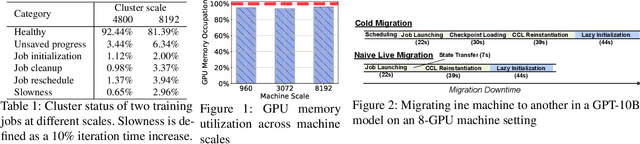
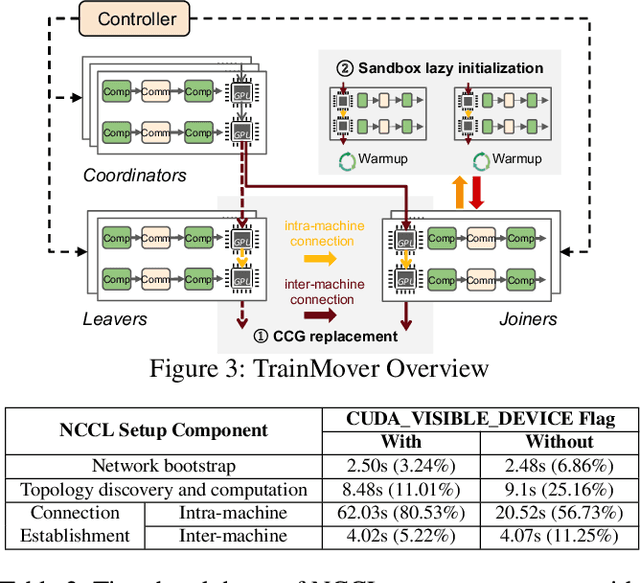
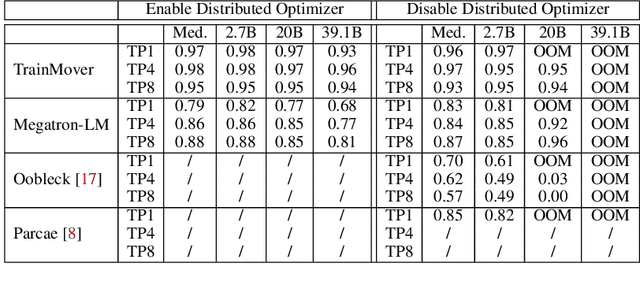
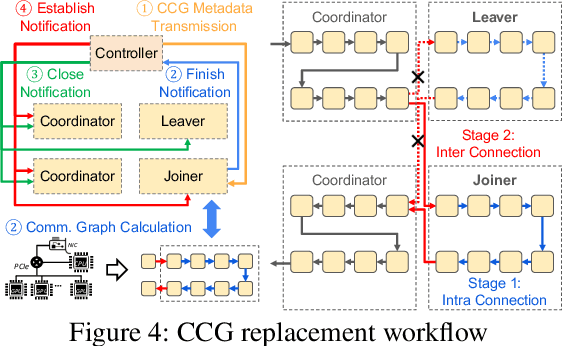
Machine learning training has emerged as one of the most prominent workloads in modern data centers. These training jobs are large-scale, long-lasting, and tightly coupled, and are often disrupted by various events in the cluster such as failures, maintenance, and job scheduling. To handle these events, we rely on cold migration, where we first checkpoint the entire cluster, replace the related machines, and then restart the training. This approach leads to disruptions to the training jobs, resulting in significant downtime. In this paper, we present TrainMover, a live migration system that enables machine replacement during machine learning training. TrainMover minimizes downtime by leveraging member replacement of collective communication groups and sandbox lazy initialization. Our evaluation demonstrates that TrainMover achieves 16x less downtime compared to all baselines, effectively handling data center events like straggler rebalancing, maintenance, and unexpected failures.
Feasible Policy Iteration
Apr 18, 2023Safe reinforcement learning (RL) aims to solve an optimal control problem under safety constraints. Existing $\textit{direct}$ safe RL methods use the original constraint throughout the learning process. They either lack theoretical guarantees of the policy during iteration or suffer from infeasibility problems. To address this issue, we propose an $\textit{indirect}$ safe RL method called feasible policy iteration (FPI) that iteratively uses the feasible region of the last policy to constrain the current policy. The feasible region is represented by a feasibility function called constraint decay function (CDF). The core of FPI is a region-wise policy update rule called feasible policy improvement, which maximizes the return under the constraint of the CDF inside the feasible region and minimizes the CDF outside the feasible region. This update rule is always feasible and ensures that the feasible region monotonically expands and the state-value function monotonically increases inside the feasible region. Using the feasible Bellman equation, we prove that FPI converges to the maximum feasible region and the optimal state-value function. Experiments on classic control tasks and Safety Gym show that our algorithms achieve lower constraint violations and comparable or higher performance than the baselines.